Evaluation of the Adherence of Elderly Volunteers Living in Retirement Homes to the Regular Consumption of High-Protein and High-Fiber Apple Compote
Published January 19, 2026
Clinical study regarding regular consumption of high-protein and high-fiber apple compote by elderly people.


|

|
Authors
- F-A ALLAERT -Chaire d’Evaluation médicale ESC Dijon - CEN Nutriment, Dijon, France.
- Guérin-Deremaux L. - Roquette Frères, Lestrem, France
- A. Mauray-Soulier - Roquette, Lestrem, France
- M-H. Saniez - Roquette, Lestrem, France ; Mastère Restauration Bien-être et Santé Lasalle Beauvais, Beauvais, France.
Context
Making sure that elderly people consume proteins and fibers in an appropriate way is a crucial concern for preventing sarcopenia and maintaining intestinal balance. Taking such dietary supplements, however, frequently comes up against a lack of adherence by elderly volunteers. In this context, apple compote constitutes an excellent matrix for protein and fiber enrichment.
Objectives
Primary Objective:
The primary objective was to evaluate the perception of the hedonic properties of apple compote containing pea protein NUTRALYS® S85XF (5.1%), hydrolyzed wheat gluten NUTRALYS® W (0.9%) and wheat soluble fiber NUTRIOSE® FB06 (6.3%) by elderly volunteers living in retirement homes, along with changes to this perception after repeated consumption.
Secondary Objectives:
The secondary objectives were to evaluate the quantity of apple compote consumed by elderly volunteers, their satisfaction regarding this consumption, the evolutions of their digestive comfort and of their fatigue following the intake of the apple compote for 3 weeks.
Test product:
Apple compote enriched in pea protein NUTRALYS® S85XF (5.1%), hydrolyzed wheat gluten NUTRALYS® W (0.9%) and wheat soluble fiber NUTRIOSE® FB06 (6.3%), biscuit flavor.
Methodology:
Observational study conducted on elderly volunteers (70 to 90 years) living in retirement homes.
The primary criterion was the Hernandez and Lawless hedonic scale. The secondary criteria were digestive comfort, measured by the Gastrointestinal Quality of Life Index, tiredness using the Pichot scale and apple compote consumption.
The apple compote was proposed every 2 days as a dessert at lunch over a period of 3 consecutive weeks. All criteria were evaluated on D0 and/or D1, D7, D15 and D21, with the exception of the quantity consumed, that was weighed after each apple compote intake.
Results:
- 24 elderly volunteers with a mean age of 83.7 ± 6.2 years, 62.5% of whom were female, were included.
- During the initial intake, the apple compote was deemed “rather pleasant” to “very pleasant” by 91.7% of the population, and this appreciation remained at 79.2% (p = 0.1797) after one week, at 83.3% (p = 0.3173) after 2 weeks and at 79.2% (p = 0.2568) after 3 weeks (graph 1).
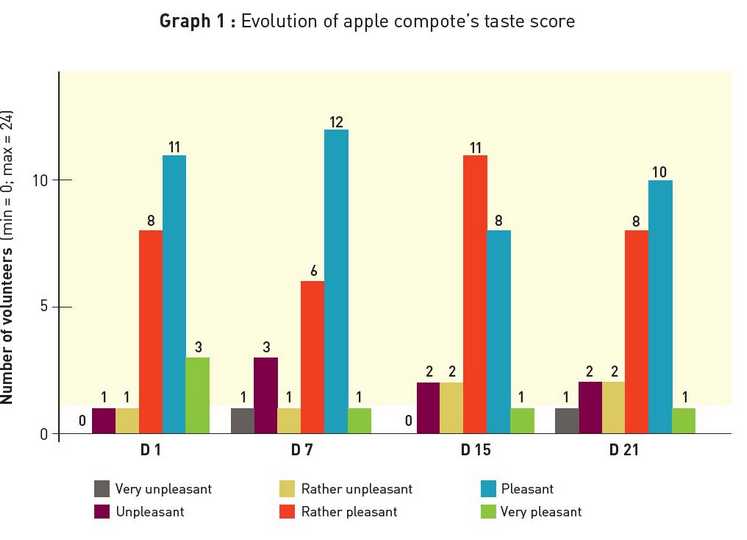
In terms of mean appreciation, opinions also remained stable, ranging from 4.6% ± 0.9% upon inclusion to 4.1% ± 1.2% on D21 (p = 0.3190), i.e. a relative value drop of 10.1%. No negative taste’s appreciation induced any stopping of the study.
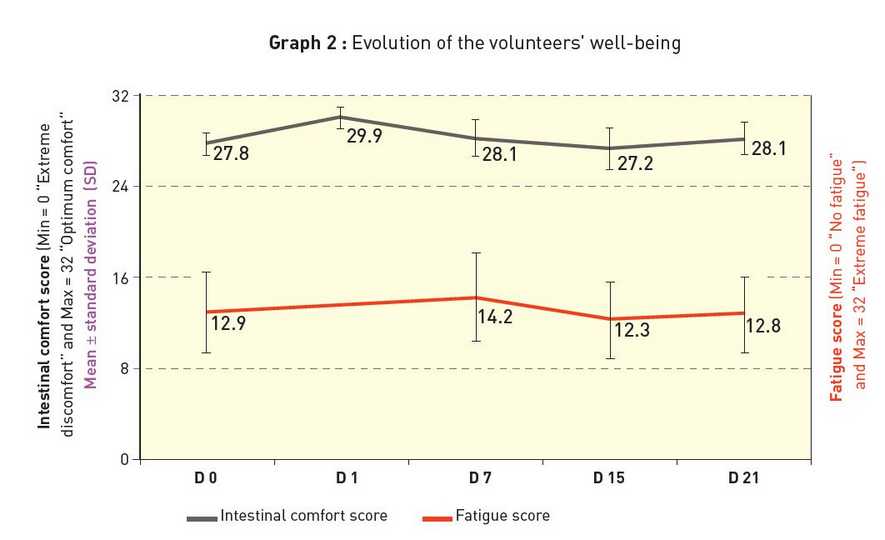
- Fatigue, evaluated according to the Pichot scale, was stable, ranging from 12.9 ± 8.5 at inclusion, to 14.2 ± 9.4 (p = 0.6547) after one week, to 12.3 ± 8.0 (p = 0.0832) after 2 weeks and 12.8 ± 8.2 (p = 0.5637) after 3 weeks (graph 2).
- The digestive comfort of the volunteers was generally stable, with variations of less than 2% between the inclusion and the end of the study (graph 2).
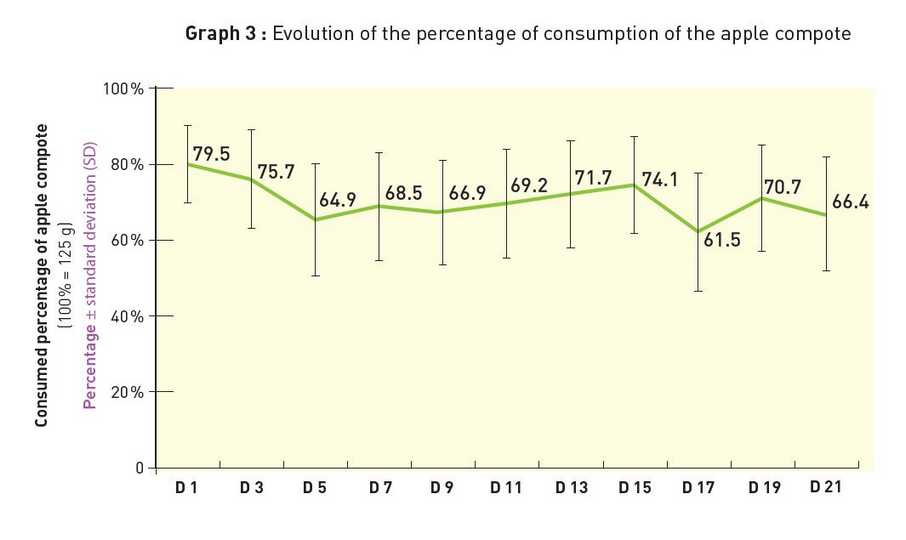
- Average amount of apple compote consumption was stable and varied between a maximum upon inclusion of 79.5% of total amount to a minimum of 61.5% recorded on D17. No notable adverse events were reported (graph 3)
Conclusion:
Nine out of 10 elderly volunteers enjoy the taste of the test apple compote and this taste adherence persists in 8 out of 10 elderly volunteers after three weeks of regular consumption. This regular consumption seems to induce neither any digestive discomfort nor fatigue in the elderly volunteers. The pea protein NUTRALYS® S85XF, hydrolyzed wheat gluten NUTRALYS® W and wheat soluble fiber NUTRIOSE® FB06 thus appear to constitute suitable protein and fiber supplementation solutions in the context of diets for institutionalized elderly persons.
LIST OF REFERENCES
In case if needed – literature cited in the article for example
DISCLAIMER
The information contained in this document is to the best of our knowledge true and accurate, but all instructions, recommendations or suggestions are made without guarantee. Since the conditions of use are beyond our control, we disclaim any liability for loss and/or damage suffered from use of these data or suggestions. Furthermore, no liability is accepted if use of any product in accordance with these data or suggestions infringes any patent. No part of this document may be reproduced by any process without our prior written permission.
© Roquette Frères S.A. - 11/2014