Slowly digested carbohydrate from Roquette
Published August 31, 2022
With a glycemic index nearly four times lower than maltodextrin, Pea Starch LN30 offers a smart carbohydrate choice for sports and clinical nutrition. Discover the data behind its performance in powder shakes and energy bar

Application in powder shake
We used pea starch LN30 in a cold mixed powder shake as in recipe A. The full formulation is described in table 1. We replaced pea starch with maltodextrin (GLUCIDEX® IT 19) in recipe B, for comparison. The solubility, sensory and GI value of both recipes were tested.
| Ingredients | Addition % | |
| Recipe A | Recipe B | |
| Pea starch LN30 | 53.67 | 0.00 |
| Whole milk powder | 23.90 | 23.90 |
| PREGEFLO® C 100 precooked corn starch | 2.80 | 2.80 |
| NUTRALYS® S85 Plus N pea protein | 14.70 | 14.70 |
| NUTRIOSE® FM 06 soluble fiber | 2.55 | 2.55 |
| GLUCIDEX® IT 19 maltodextrin | 0.00 | 53.67 |
| Thickener (guar gum) | 1.30 | 1.30 |
| Flavor (milk) | 0.539 | 0.539 |
| Salt | 0.387 | 0.387 |
| Aspartame | 0.103 | 0.103 |
| Acesulfame K | 0.051 | 0.051 |
| Total | 10.00 | 100.00 |
Table 1. Formulation of recovery powder shake. Recipe A used pea starch LN30 as the main carbohydrate; recipe B used maltodextrin GLUCIDEX® IT 19 instead.
Instruction for use: dissolve 50g of the powder shake in 230 ml water (temperature: no more than 50℃).
Observation: The recipe B (30s) has better dispersibility than recipe A (40s).
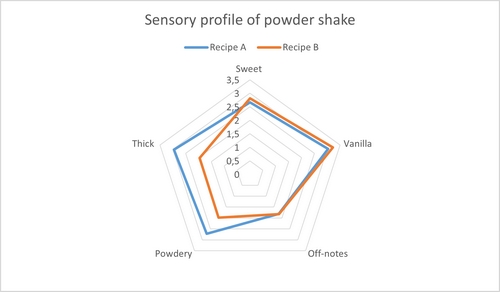
Figure 1: Sensory profile of both recipes. It is an internal test done by 10 volunteers. Recipe A is a powder shake with pea starch LN30; recipe B uses maltodextrin GLUCIDEX® IT 19.
We can see the following from the sensory profile of powder shake (figure 1):
Recipe A with pea starch LN30 has a smooth texture (thanks to its thickness) and clear taste. It is very close to recipe B in terms of taste. In terms of mouthfeel, Recipe A showed a slight powdery effect and thicker texture. This second characteristic can be easily adjusted by decreasing the amount of thickener. It also has no off-notes. The glycemic index of both recipes was tested at Oxford Brookes University in December 2019. The GI of pea starch LN30 recipe (recipe A) is about 18±3.7, classified as a low GI, whereas it is 66±8.1 for GLUCIDEX® IT 19 recipe (recipe B), classified as medium GI.
Application in energy dough bar
Pea starch LN30 also performs well in cold process dough bar. Sixty percent of the energy comes from carbohydrates in which pea starch LN30accounts for 55% in this recipe. The texture is soft, and the taste well appreciated. When replacing the pea starch LN30 with another native waxy maize starch, using the same recipe, it is hard to shape as a bar, and it has a hard bite.
Conclusion
Pea starch LN30 from Roquette is very suitable for cold processed mixed powder and energy bar products. It is a slow digestive starch and has a neutral and smooth taste.